What is Dream?
The Rhythms in the innerdance Playlist simulates the circadian rhythms, bringing reversals and inversions to our internal clockworks, which conditions how we are aware of Time.
Simply, we are able to experience Dreaming during Wake State Consciousness, which normally only happens during REM Sleep.
Why and How does this happen? What does it mean that the innerdance awakens sleep consciousness, allowing us to perceive what Time looks like while we are asleep?
Simply, we are able to experience Dreaming during Wake State Consciousness, which normally only happens during REM Sleep.
Why and How does this happen? What does it mean that the innerdance awakens sleep consciousness, allowing us to perceive what Time looks like while we are asleep?
Stages of Sleep: The Sleep Cycle
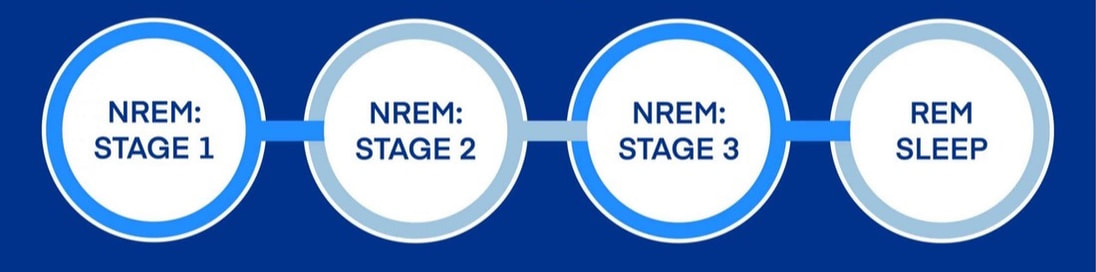
- NREM1 - the lightest stage of sleep. The EEG brain frequency is slightly slower than during wake time. There is muscle tone present in the skeletal muscles and breathing occurs at a regular rate. Everything starts to slow down, including eye movement. There is a sensation of falling with sudden muscle contractions called hypnic myoclonic or jerk. Brain waves spike between theta to beta.
- NREM2 - As the body prepares to enter deep sleep, the sleeper is less able to be awakened. Stage 2 sleep is characterized by 'saw tooth waves' and sleep spindles allowing brain waves to slow. As eye movement stops, heart rate slows and body temperature decreases.
- NREM3 - called ‘Slow Wave Sleep’ (SWS), N3 emits a much slower frequency with high amplitude signals mostly through delta waves. A sleeper in deep SWS is often difficult to awaken. There is no eye movement or muscle activity and when people are awoken from this stage, there is a disorientation and sometimes a feeling of intense paralysis.
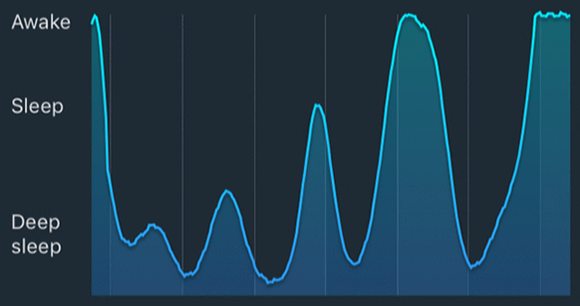
- REM - This stage of sleep is associated with dreaming. EEG readings in REM resembles wake states, as the eyes begin to move, breathing becomes more erratic and irregular and heart rate increases. When a person enters REM sleep, brain activity increases again, meaning sleep is not as deep. Usually, REM sleep arrives in the first hour and a after sleep occurs. The first REM period lasts about 10 minutes. Each REM stage that follows gets longer and longer.
What would reality look like if we woke up within our various sleep stage?
|
A Fourth State
In Psychology, there are traditionally only three States of Consciousness: Wake, Non-REM Sleep and REM Sleep. The innerdance signifies a fourth possibility: the REM Wake State. Such as state is non-existent and is rarely considered. To look at such, we would consider the various mental processes when Time Perception expands as it does during psychedelic journeys, dreaming, the near-death experience and in spiritual awakenings. |
Before hosting a discussion regarding innerdance as a brain entrainment process that makes REM Wake possible, here is a basic introduction to REM Sleep Stages:
|
|
The body's neural oscillations separate Wake from Sleep. As such, our brain regions and functions were carefully designed over Deep History to inhibit REM awareness during Wake, when Beta-Gamma alertness is prioritized over Delta-Theta slowness and drowsiness. When we allow REM stages to take place during the Day, very old patterns are reconditioned, shifting oscillatory sequences which took millions of years to program and congeal.
|
In understanding how these patterns change over time, it is important to ask
how were they first conditioned? when were they first noticed?

|
The Circadian Rhythms as a Chronobiological device was first regarded by a French astronomer named Jean Jacques d'Ortous de Marian when he studied the mimosa piduca, a small flowering plant that folds its leaves when touched. It is aptly called the shameplant, touch-me-not, sensitive plant, and sleepy plant, based on the fact that the mimosa's leaves go to sleep at night, becoming the first organism that demonstrated to scientists that a day and night clock is internally programmed within living things. de Marian took the mimosa into dark rooms and found that even without exposure to sunlight, the mimosa's leaves folded on a day and night schedule.
|
The highly emotional, sensitive and reactive mimosa signifies the same sensitivity that touches all organisms exposed to all external conditions, including sunlight, touch, sound, heat, etc. Through our eventual study of the Circadian Rhythms in a myriad of other plants and the known animals and microorganisms, rhythmicity is now known to exist, revealing key insights on our internal psychological and physiological structures, many of which are affirmed in the innerdance process:
- Our mental states are superimposed upon deep biological conditionings, entrained by an assemblage of experiences on the earth that have eventually determined our "big picture" reality. Our bodies store response mechanisms to threats and opportunities, integrating ancient memories of painful and happy events shared across a multitude of species that were exposed to varied rewarding and stressful situations onto a wave pattern. This pattern determines when it is safe to sleep, eat, rest, and when it is viable to work, protect, fight.
- One's personal body clock is founded on how one has reacted to all life experiences since conception, and through heredity, since our first ancestors decided on what can be trusted and what should be feared.
|
|
When participants first experience deep Wake REM in the innerdance, their bodies learn to respond differently to highly stressful and emotional stimulus, as their heartbeat, their breath rate and their brain states are deeply affected. In this light, change happens when the body learns to transform itself by reacting differently to childhood and ancestral events. In singular situations, a set of integrative decisions through synchronizations across many regions of the brain, extending to the various landscapes in the body that functionally hold the patterns in a gestalt wholeness.
additional audio material
Dream Awake - by Pi
Key words: facilitating the circadian rhythms through sound; homeostasis; states of consciousness.
Key words: facilitating the circadian rhythms through sound; homeostasis; states of consciousness.

click on the image to access the file